

Reserve Your Free eBook
To celebrate the launch of Uncertain Lives, I’m giving away 20 copies of my book.
Stories matter. Sometimes they comfort us, sometimes they challenge us, and sometimes they arrive at exactly the right moment.
So whether you want a new read yourself, or you know someone who’d love a thoughtful surprise, you can enter to receive Uncertain Lives either from Apple or Amazon.
You can:
• Treat yourself to something new to read
• Gift a copy to a friend who needs a lift
• Or simply share a story with someone you care about
Let’s celebrate the joy of books and the joy of passing them on.
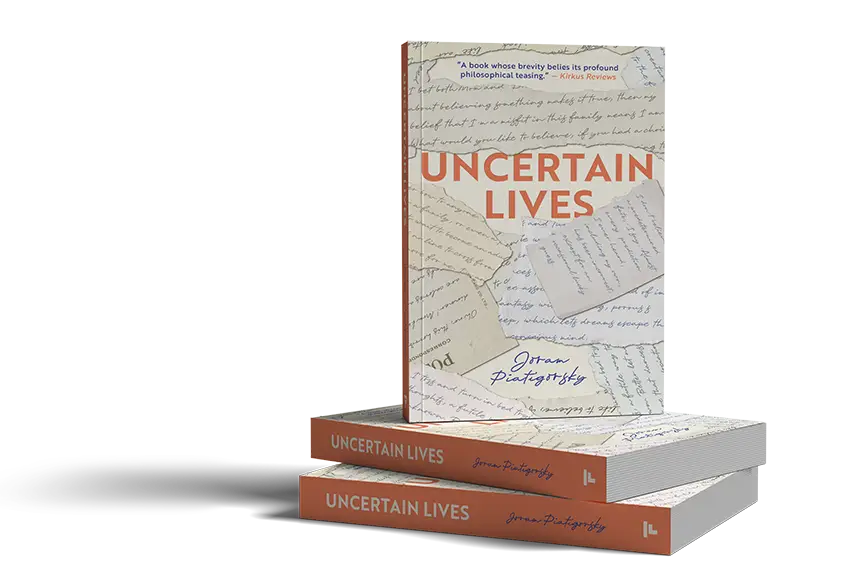
In Uncertain Lives, Joram Piatigorsky weaves a richly layered literary novel about friendship, identity, and the shifting boundary between reality and imagination.
Angela, a journalist, has spent a lifetime in the orbit of her brilliant and enigmatic friend, Devra—a scientist, a loner, and a woman who has always resisted being fully known. When Devra, now in failing health, allows Angela access to her private writings—stories, essays, reflections—a new and unexpected narrative unfolds.
As Angela sets out to write Devra’s biography, she is drawn into a labyrinth of ideas and inner worlds. Devra’s writings challenge everything Angela believes about memory, truth, and the self: Are we singular, coherent individuals—or collections of competing identities shaped by chance, perception, and desire?
Through a seamless interplay of narrative voices and embedded stories, Uncertain Lives becomes both an intimate portrait of a lifelong friendship and a profound exploration of the human mind.
At once philosophical and deeply human, this is a novel for readers who are drawn to searching questions, emotional complexity, and the beautiful uncertainty at the heart of existence.
Advance Reviews
Both fascinating and philosophical, Uncertain Lives is a rare synthesis of three aspects of storytelling. First—revelations in a lifelong friendship between two women, Angela, a journalist and mother, and Devra, a scientist and loner. Second—immersion into Devra’s secretive writings. And third—exploration of the nature of thought, imagination, identity, reality, and truth within, as Piatigorsky writes, “the beautiful paradox of the uncertainty principle.” Devra, facing death, allows Angela, who will write the biography of her esteemed friend, to read her previously unknown stories and essays. These engrossing writings create a book within this book that unfolds the enigma of Devra and her research on the values of uncertainty, while Angela yearns to be recognized as a key friend in Devra’s history. A character in one of Devra’s stories says, “How satisfying and beautiful when art and science blend,” and I found Joram Piatigorsky’s novel to be the perfect expression of this truth.
—Eugenia Kim, author of The Kinship of Secrets
A jam-packed novel of ideas, the book uses Devra’s writing to explore everything from childhood sexual assaults to musings on octopus brains, the role of uncertainty in life, and the question of whether we are singular individuals or merely collections of shattered identities. Moving through the first-person voice of Allison, who herself is fractured by the name that Devra gives her, the book traces both how a life is constructed from the inside, through Devra’s diaristic writing, and how it becomes interpreted and understood by another in the eyes of Allison. The result is a novel that asks the big questions about how we construct reality—and whether we can ever claim to know it fully.
That thematic boldness is reinforced by the novel’s structural play. Allison’s time with Devra and her writing slowly takes shape as an experimental biography within the novel: Devra Denniston: A Life Imagined.
Joram Piatigorsky has crafted a caring, searching novel, at once the story of a lifelong friendship and a brilliant rumination on how we come to know others and ourselves. It asks the question: Is reality simply those fantasies we’re able to will into existence? I love a book that leaves me curious about its ideas after I finish reading, and I know I’ll keep thinking about Uncertain Lives for a long time to come.
—Zach Powers, author of The Migraine Diaries and First Cosmic Velocity
In Joram Piatigorsky’s remarkable novel, Uncertain Lives, readers are introduced to two seventy-five-year-old women, Devra and Angela, whose lifelong friendship serves as context for the narrative. Devra is dying. She has never married and stands out as an accomplished scientist and occasional writer. Angela, a journalist, visits Devra almost every day, demonstrating a commitment reminiscent of Mitch Albom’s Tuesdays with Morrie. Devra shares her journal, essays, dreams, and short stories with Angela. Her writings are beautifully crafted vignettes that delve into life’s most profound questions. Through elegant metaphors and shrewd parables, Devra explores topics such as the nature of memory, the boundaries between dream, reality, and imagination, the different personalities that can inhabit a person, and the extent to which people can truly know one another. The two friends ponder the purpose of life, debating how much of a person is shaped by experience and happenstance versus genetic predisposition. These inquiries are left intentionally unresolved, inviting the readers to open their minds rather than slide into tight, uncompromising conclusions. Ambiguity is at the forefront. After Devra’s passing, Angela publishes her writings achieving literary and financial success.
—Tudor Alexander, author of Planet New York and The Last Patient
Joram Piatigorsky’s captivating novel, Uncertain Lives, is a richly cyclical portrait of the scientific mind tempered by a humanistic heart. On the surface the book is an engrossing tale about two women seemingly sisters but fiercely competitive, one a scientist working in the realm of gene sharing and evolution, as Piatigorsky did in his pre-novelistic career as a molecular biologist, and the other a journalist struggling to write a biographical novel. On a deeper level the tensions of the two worlds of art and science, as well as the very nature of scientific inquiry with its uncertainty of absolutes and its persistent questioning and the contingent relationship between art and reality, are brought into an engrossing new and sharp perspective.
—Janice L. Ross, author of
and Like a Bomb Going Off: Leonid Yakobson and Ballet as Resistance in Soviet Russia
In Piatigorsky’s novel, a journalist is determined to write an honest biography of her best friend—a project that proves to be a profound philosophical and metaphysical challenge [. . .] it explores the boundaries between reality and imagination [. . .] Certainty and uncertainty also play a large part in the narrative—so much so that one starts to wonder how close these “blood sisters” really are [. . .] such is the atmosphere of deception and gaslighting in this story that readers can’t truly be sure [. . .] A book whose brevity belies its profound philosophical teasing.
—Kirkus Reviews